The 61-Point Gap
Most people in your company can use AI. Almost none of them do. That gap is not a tools problem. It is a bridge problem.
Capability without adoption is the most expensive number in your company right now.
IBM surveyed 2,000 CEOs at companies averaging $5.8 billion in revenue. Two numbers from that study should be taped to every boardroom wall.
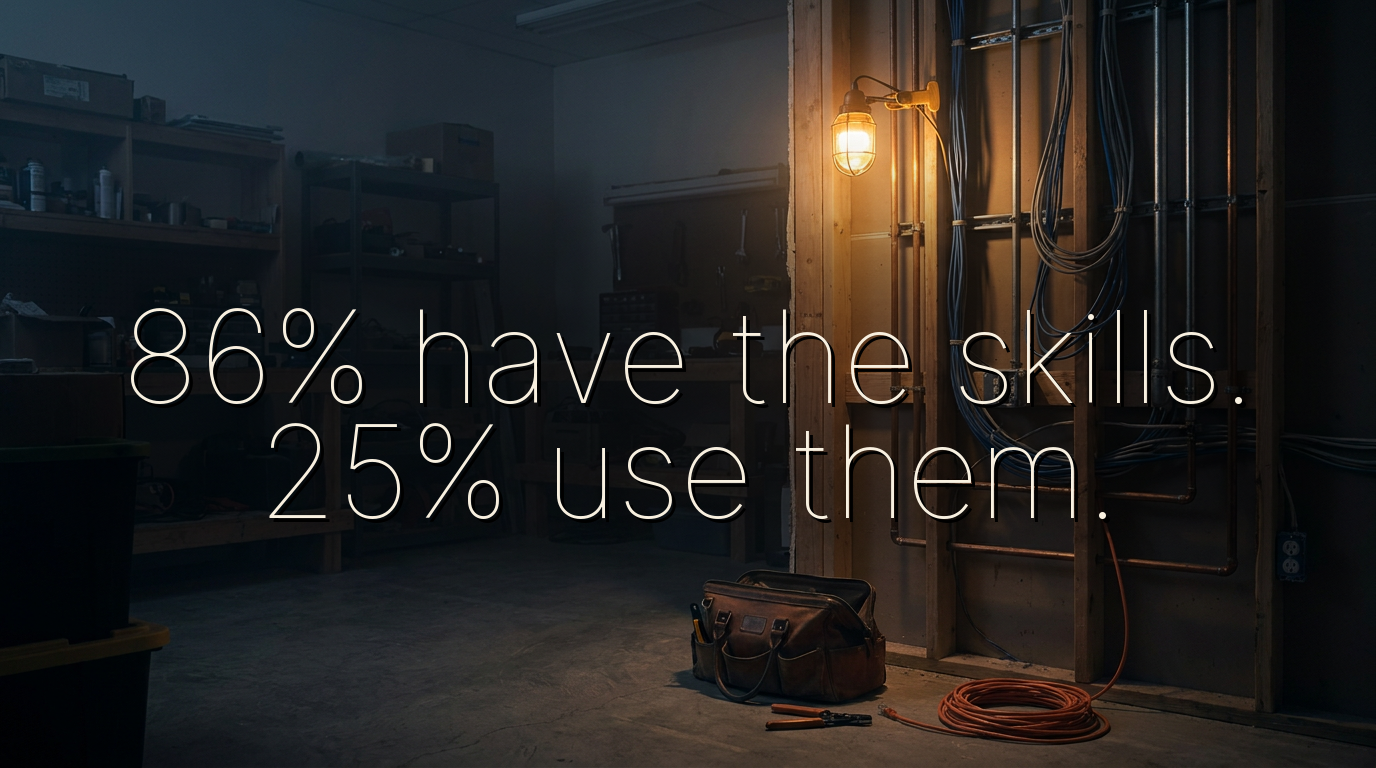
86% of employees have the skills to use AI, or could pick them up with light training.
25% actually do.
That is a 61-point gap between what your people can do and what they actually do. It is not a tools problem. It is not a training problem. It is a bridge problem. And right now most of the panic in the C-suite is the sound of CEOs realizing they do not have anyone to build the bridge.
83% of the CEOs in this same study said AI success depends more on people’s adoption than on the technology. That is the thesis of this article in IBM’s own words, sitting in their own data, and almost nobody is acting on it.
The pain is real, and it is louder than the press releases
76% of the CEOs in this study have a Chief AI Officer in 2026. One year ago that number was 26%. The role barely existed.
So a job that was a footnote in 2025 is now the most contested seat in the C-suite twelve months later. That does not happen because executives are excited. That happens because executives are scared.
They are hiring frantically. Reshuffling org charts. Announcing AI committees. Spinning up AI-native sub-units rather than retraining the people they already have, because retraining the existing org is brutal and slow and politically expensive.
The CEO is in pain. The employees are in a different pain. They are quietly using AI at home and quietly hiding it at work because nobody told them whether they are allowed to. The CMO is in a third pain, because 85% of CEOs in this study said every functional leader has to become a tech expert, and the CMO did not sign up for that when she took the job.
Everybody is staring at the same gap from a different side of the canyon.
The gap is not where you think it is
It is tempting to read this and say the gap is a skills gap. It is not.
86% of employees already have the skills. The CEOs themselves said so. That number is not a hope. That number is the floor.
The gap is between the people who could use AI and the workflows that need it. Nobody is connecting those two things. Nobody is sitting with an employee and saying show me your Tuesday afternoon and let me find one hour we can give back to you. Nobody is saying here is what your daily report looks like, and here is what it looks like with AI doing the first draft.
That work is unglamorous. It is not a strategy deck. It is plumbing.
And plumbing is exactly what is missing.
The rollout was malpractice, not novelty
I have been saying this on client calls for months and I will say it here.
The reason AI adoption looks like a disaster is not that AI is hard. It is that the rollout has been malpractice. No onboarding. No change management. No one sitting with the team to walk them through what changes Monday morning. Tools dropped into Slack with a link and a shrug. Licenses paid for and never logged into. Policies announced and never trained.
Large orgs should have run this like any other enterprise rollout. They did not. They treated a workforce transformation like a software install. That is the actual story behind the 61-point gap, and the data backs it up: 86% have the skills, 25% use them, because nobody built the runway between those two numbers.
Small orgs have a different version of the same problem, and it is worse.
It is not that the operator running a coaching practice or a small agency is not technical enough, although sometimes that is part of it. The bigger problem is time. Nobody inside a small business has an hour this week to sit down and figure out which workflow to rewire first. Everyone is already at full burn. There is no slack to learn, experiment, fail, try again. The skill is reachable. The hour is not.
So the work does not happen. And the gap compounds, because the operator who delays six months is not six months behind. She is six months behind a peer who is now compounding.
The bridge is a role, not a tool
There is a reason the Chief AI Officer seat went from 26% to 76% in a single year and it is not because anyone figured out what the job is. In a separate IBM IBV report on CAIOs, 40% report to the CEO, 24% to the CIO, the rest are scattered. Nobody can agree on what the role is. They just know they need somebody who owns it.
For a Fortune 500, that somebody is a full-time hire.
For a coaching practice, for a $2M agency, for a leadership consultancy, for almost everyone reading this, that somebody is not a hire. That somebody is a person who is AI and tech forward, who understands how systems and processes actually move inside a small business, and who can build new systems that give hours back. Comes in. Sees how the work actually moves. Rewires it one workflow at a time. Documents the saved hours. Hands the new system back. Leaves.
That is the work I do. I am naming it because the pattern I keep seeing is operators who know they need this and do not know it has a shape yet.
The fractional bridge is not a discount on the real role. It is the real role for everyone outside the Fortune 500.
The gap is real. The pain is real. The seat is being invented in real time, and most of the people who will eventually fill it are not credentialed for it yet. They are just paying attention.
If you are paying attention, you are already early.
If you are a coach reading this and the gap inside your own practice is what is making you tired, that is a bridge problem. Not a learning problem. Not a tools problem. Somebody has to wire it for you, or sit next to you while you wire it yourself.
That is the work right now.
Sources
- IBM, CEOs are Reshaping C-suite Roles for the AI Era (newsroom release, 2026-05-04): newsroom.ibm.com
- IBM Institute for Business Value, How Chief AI Officers deliver AI ROI: ibm.com