The Reality of Agentic Infrastructure vs. Aspiration
Why the strategic gap in AI isn't the quality of the output, but the architecture orchestrating it.

I spent last week building two systems.
Paperclip, a control plane that hands tasks to agents and tracks them. And Briefly, a pipeline that pulls content through stages and ships it.
One truth kept surfacing, the kind you cannot unsee once you see it.
The strategic gap in building AI systems isn’t the quality of the output. It’s the architecture orchestrating it.
The output is great. That is the trap.
When you design an agent’s persona, the voice rules, the things it must never do, the quality gates it has to pass, the results come back remarkably sharp. It sounds like it knows what it is doing.
So you start writing your operating docs as if the plumbing under the agent is as grown-up as its language. You write a Monday-morning workflow that fires on a schedule, reads performance numbers out of a database, and routes content across five stages on its own.
But the schedule does not exist yet. The database read is not wired. The routing is a wish.
This is treating aspiration as architecture.
The gap between the words and the wiring
The agent talks like a senior operator. The infrastructure under it is a half-built house.
Aspiration is what builds the future. Confusing it with what you have right now is a straight path to hallucination.
Hand an agent instructions written for a system that does not exist, and it stalls. It was told to pull the clock, and there is no clock.
Phase the ambition
The fix is to graduate the agent in two phases, not launch it at full autonomy on day one.
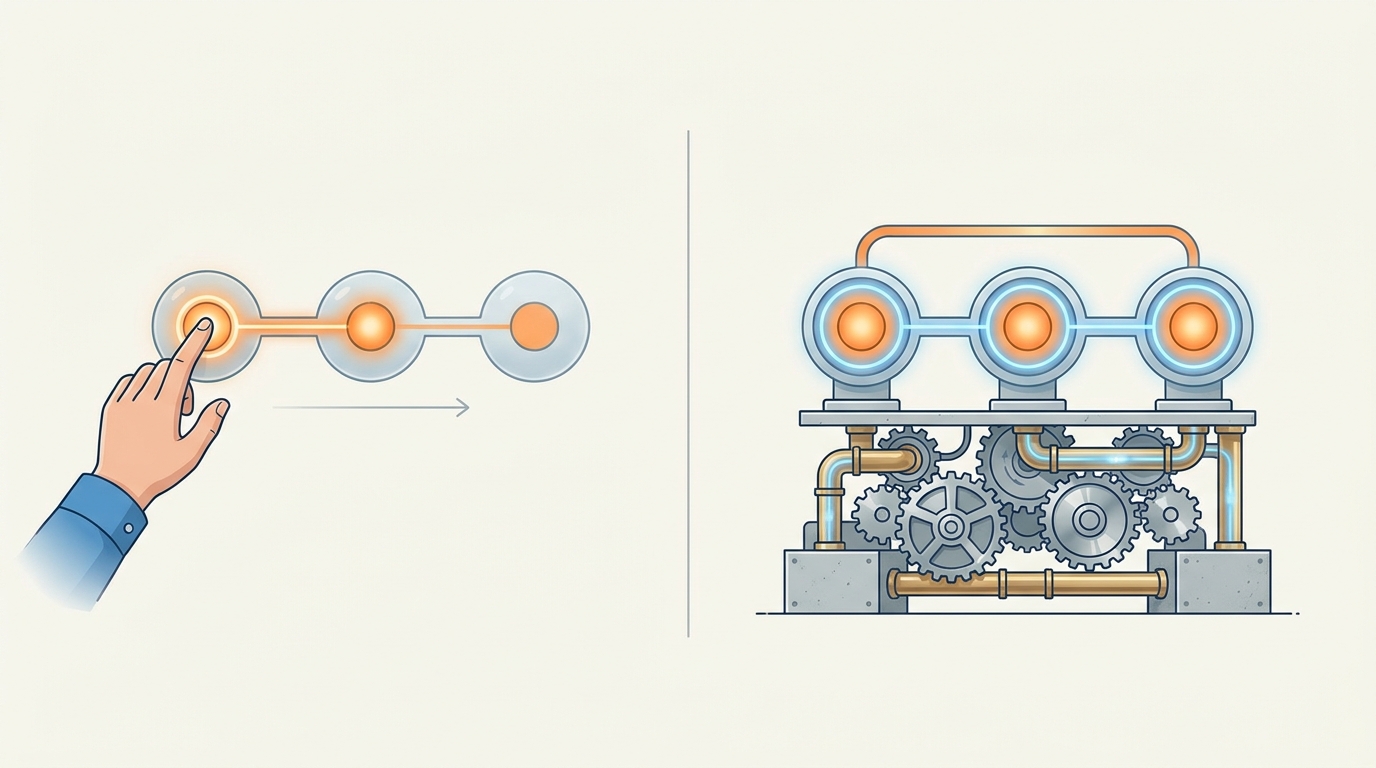
Phase 1, Assisted Production. Take the same tight persona files and logic. Run them as workflows that you trigger by hand. You are the human-in-the-loop, the person who checks each step before it proceeds. Use a checklist. Run the manual version for four to six weeks.
Phase 2, Autonomous Production. Only when the wiring underneath catches up do you let the agent self-start. The wiring means the triggers and schedulers, the automated jobs that fire on a clock or an event. It means the RLS policies, the row-level security rules that decide which rows each user is allowed to see. When those are real, the agent graduates.
Not before. The order is fixed.
Clarity comes through building
You do not plan your way to a working system. You build your way there.
Let the agent’s real failures, the ones it hits while you run it by hand, shape the next piece of architecture you build.
Not the failures you imagined. The ones that actually happened.
That is the only feedback that tells you what to wire next.